Why Travel’s Execution Gap Needs to be Closed Before Conversational AI Can Work
TOR LEELO, CPO, WENRIX / JANUARY 23, 2025
For the last two years, the travel industry has been sprinting toward one shiny idea: AI will fix everything. New chatbots, new copilots, new digital agents — every week brings another demo promising to eliminate traveler frustration and operational chaos.
And yes, chatbots are genuinely great at talking. They understand intent. They’re polite. They empathize like champions.
But here’s the truth the industry keeps dodging:
The real problem with travel isn’t conversation. It’s execution.
The Execution Gap: Travel’s silent blocker
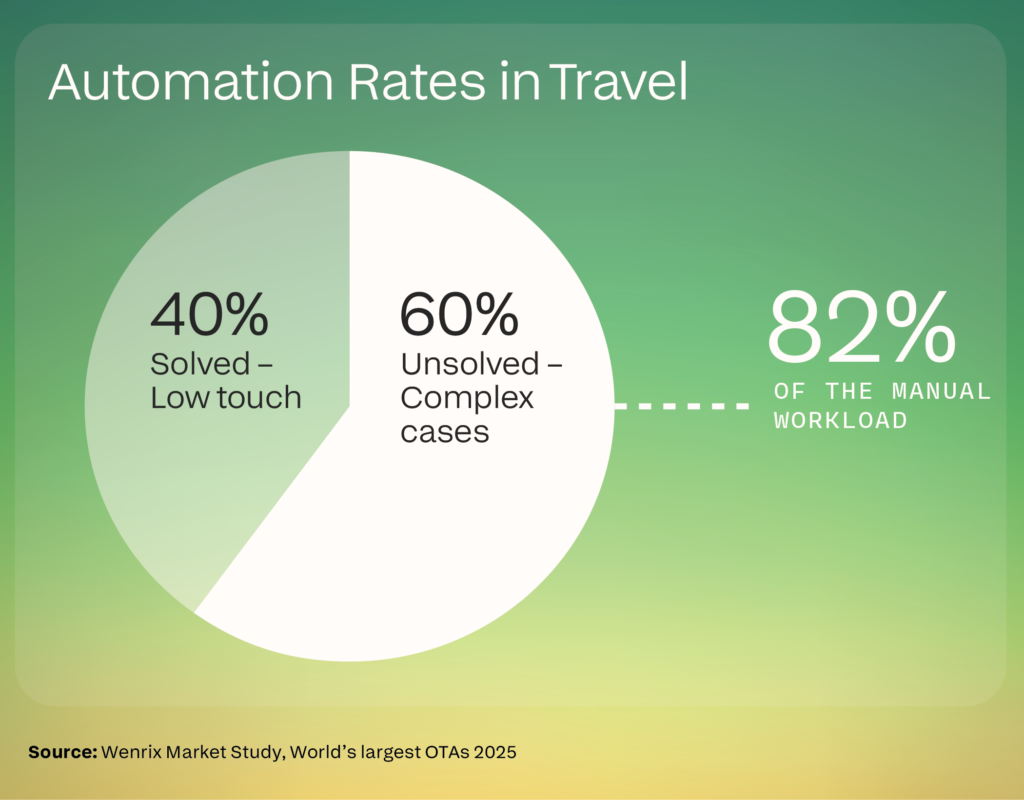
Different agencies and third-party technologies have automated the easy 40% of traveler servicing requests.
The remaining 60% continues to be handled manually by large call centers and human agents.
These are the complex, rule-heavy, edge-case-ridden tasks where automation breaks down. As a result automation ends up delegating work back to human agents— consuming 82% of agent time, driving servicing costs up, increasing errors, slowing the user experience, and causing significant traveler frustration.
Travelers don’t want another chatbot that “understands their frustration”.
They want:
- An immediate, correctly processed refund
- A disruption resolved without escalation
- An upgrade that doesn’t require a prayer circle
Right now, none of that is reliably possible — not because AI isn’t capable, but because the infrastructure underneath is cracked.
The moment a conversational layer or agentic AI attempts to take action, such as canceling a ticket, applying a waiver, or issuing a refund, the abstraction breaks down, and the underlying system complexity is exposed.
Why?
Because behind every “simple” request is a labyrinth of:
- Airline rules
- Fare restrictions
- Penalties & taxes
- Disruptions
- Regional regulations & waivers
- Booking context and history
- Agency-specific workflows
- Pricing & incentives
- Ancillaries policies & fees
More than that, the automation used by agencies today breaks down due to fragmented systems and airline-specific logic and workflows. The infrastructure must handle complex requests and scenarios such as multiple passengers, partially refunded tickets, ancillaries, multiple forms of payment, virtual interlining, and a long tail of operational edge cases.
There’s no standard. It’s not clean. And none of it was built for machines.
Why the industry has never solved this
For years, fixing the execution gap hasn’t been a priority for the industry. The problem was too complex, and it became normal to route difficult servicing requests to outsourced human agents. It was slow and inefficient, but eventually, the issue got resolved.
Today, in the era of AI, that approach no longer works. This is no longer just about reducing servicing costs. Travel’s technology leaders know it’s about meeting new expectations for instant, accurate, self-service support.
NDC Offers & Orders has made it even more complex
And just when the industry needed simplicity, NDC added more complexity.
Agencies now operate across EDIFACT and NDC, across GDS, Aggregator, and Direct Connect—each with different rules, data structures, and servicing limitations. Whilst NDC fare rules are often more structured, every airline is at a different stage of implementation. Many still lack support for key servicing scenarios like partial refunds, disruptions, ancillaries, and multi-leg journeys.
This has left Agencies navigating multiple interpretations of “standard” across multiple NDC channels and sources, each with different gaps.
Which means that many NDC servicing requests still fall back to manual handling.
For Agencies to truly enable automated servicing, they need an execution layer that can also automate servicing tasks that the Airline API doesn’t even support yet.
That became even more complex in the new era of Offers & Orders with multiple NDC channels. While fare rules aim to be more structured, each airline is at a different stage of implementation, and many complex operations still require manual intervention. These can be automated even when they are not supported by the airline API.
Why all Agentic AI solutions aren’t made equal
As a result, many companies now promise to solve this with agentic AI. And while it is powerful, it’s not a miracle worker. It still needs:
- Access to booking data, ticket data, booking history, flight disruptions, availability, tax rules, and related metadata
- Deep understanding of complex airline policies and workflows
- Deterministic execution paths based on historical human decisions and context
- Connectivity across all air content sources, suppliers, and connection types
- The ability to integrate with agency internal systems and third-party providers
Without that foundation, agentic AI does what it does best under pressure:
- hallucinate,
- hedge,
- escalate,
- or commit small-but-deadly errors.
A refund that’s $20 off isn’t an “oops.”
It’s an ADM.
A traveler who is struggling with changes or airline upgrades handled directly by the airline rather than the agency is not an inconvenience.
It’s a leak in your revenue pipe.
In the past, this was too complex to automate and was handled manually by adding agents—slow, but the servicing request was eventually resolved.
Today, it’s not only about cost; it’s about meeting travelers’ expectations for instant, seamless service—and fitting into an agentic AI world.
Agentic AI needs a servicing infrastructure that’s precise, consistent, and machine-executable. If we want an AI-powered future, the servicing foundation must be rebuilt — not decorated.
The missing piece: An AI Execution Layer that goes deep and wide
Travel needs an execution layer — a system that can actually do things.
A layer that can:
- Go wide across the entire servicing life-cycle
- And go deep into all of the servicing edge cases
- Can automate NDC servicing tasks the airlines haven’t released the capabilities to do yet.
And beyond that:
- Understand the full booking and request context
- Interpret rules, penalties, waivers, and taxes
- Choose the correct workflow
- Execute across EDIFACT, NDC, LCCs, Direct Connects, BSPLink, ARC IAR
- Respect agency-specific logic
- Sync everything cleanly into mid- and back-office systems
Only when this layer exists can agentic AI become operational — able not just to talk, but to act.
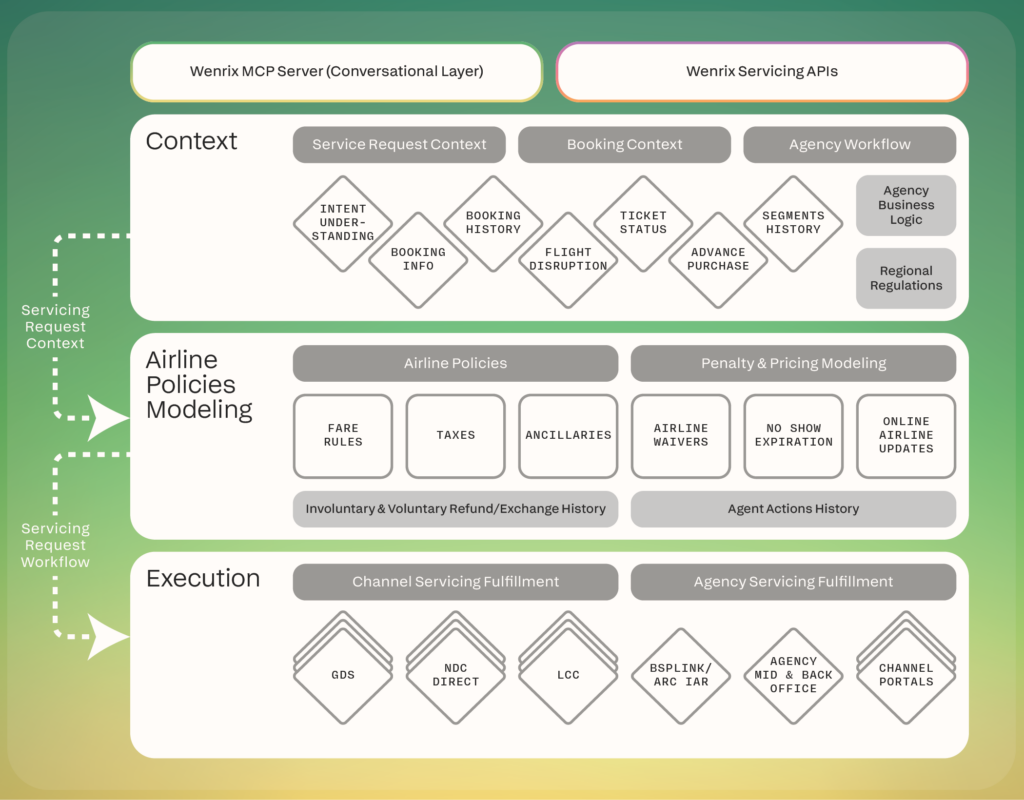
This is exactly the gap Wenrix set out to solve. Over the past eight years, we’ve built automation modules used internally across our products to support the world’s largest OTAs and TMCs. Wenrix addressed this out of necessity for our other products—what were edge cases for others were core requirements for us. Over the last two years, driven by the growing needs of our partners, we’ve focused on externalizing this technology and turning it into an execution layer for end-to-end servicing automation for the largest global agencies.
This platform became Wenrix DeepFlow.
DeepFlow automates the entire servicing lifecycle — refunds, changes, disruptions, ancillaries, no-shows, waivers, inquiries — across every airline channel.
It’s powered by:
- $50bn in real servicing data and agents’ actions,
- Verified agent actions from 60+ global OTAs & TMCs
- Eight years of edge case by edge case servicing engineering
This dataset and experience simply don’t exist anywhere else in travel.
That’s why we’re seeing 93%+ automation in production. Not in slides. In the real world.
Fix the foundation. Unlock the AI future. Become proactive.
With DeepFlow as the execution layer, the industry can finally deliver:
- A chatbot doesn’t just “understand your request” — it resolves it
- Refunds happen instantly
- Disruptions are fixed before the traveler even asks
- Upsells are contextual and actually welcome
- Agents no longer spend their day deciphering fare rules
Fix the execution layer, and the AI era can finally become real.
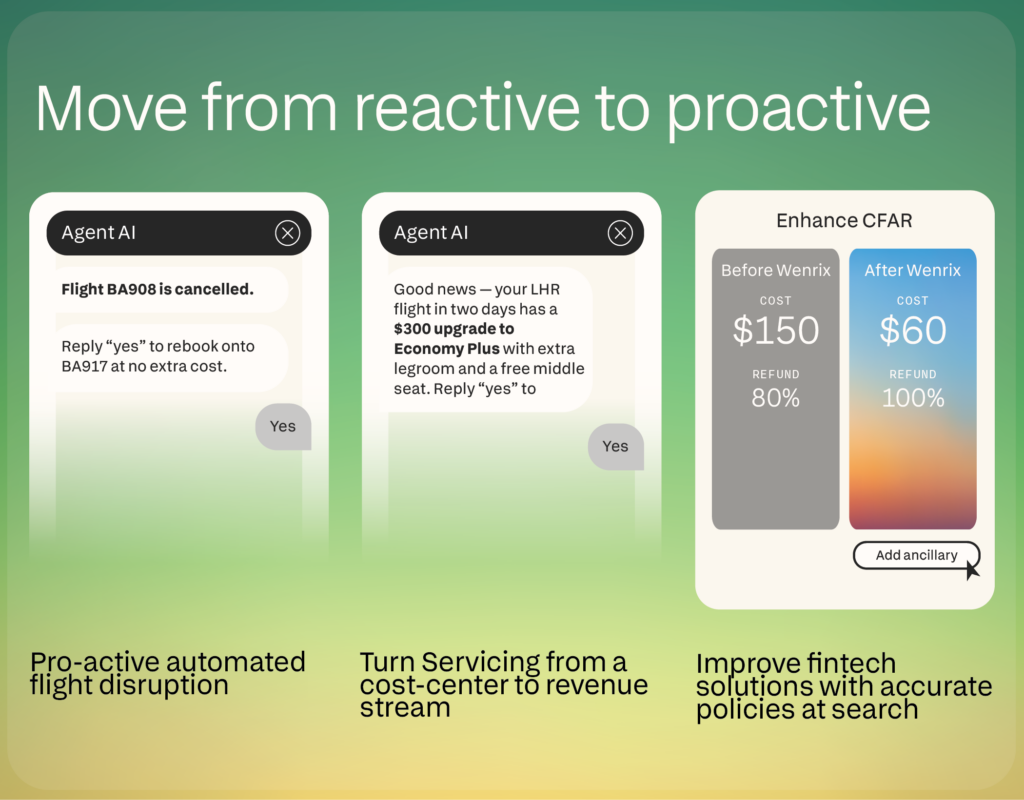
That world isn’t hypothetical anymore. It’s emerging right now — and it starts by fixing the foundation. Agentic AI can only thrive when the servicing infrastructure underneath it is accurate, reliable, and built to execute at scale.
It unlocks new possibilities, helping you to move from being reactive to proactive: automatically handle flight disruptions, shift servicing from a cost center to a revenue driver by boosting upsells – all driven by real-time deals.
Conversation is easy. Execution is everything.
Fix the execution layer, and the AI era finally becomes real.