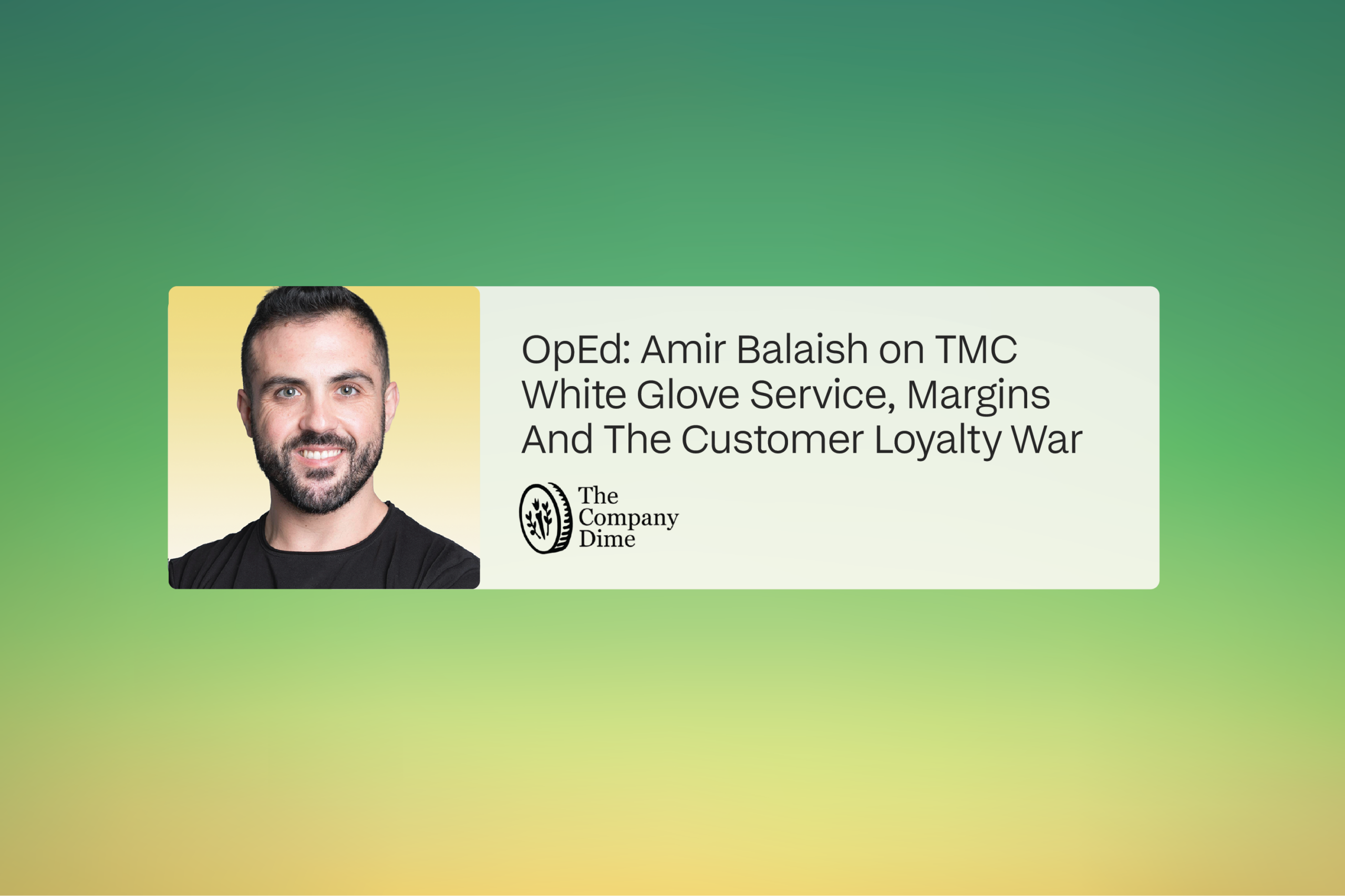
Op Ed: Amir Balaish On TMC White Glove Service, Margins And The Customer Loyalty War
AMIR BALAISH, CEO, WENRIX / THE COMPANY DIME / MAY 18, 2026
This article was originally published in The Company Dime.
White glove service never was really about human intervention, argues Wenrix co-founder and CEO Amir Balaish. It was about the outcome.
For as long as anyone in corporate travel can remember, white glove service has meant the same thing: a dedicated consultant, a direct line and a person who knows your preferences and sorts out everything for you. But with the increased adoption of Generative AI and faster, seamless servicing delivered in other industries, the definition of white glove has changed. Corporate travelers no longer equate great service with access to a person.
They equate it with the absence of effort.
According to Wenrix research conducted in April, 72 percent of 502 people who traveled as part of a managed program within the preceding year were comfortable with AI managing a rebooking during a disruption. Among the respondents, who were based in the United States, United Kingdom, Singapore or the United Arab Emirates, 4 percent said they never wanted anything handled automatically. Fourteen percent wanted to speak to a human agent when something went wrong.
Corporate travelers are asking for resolutions that are instant, proactive and frictionless. A human is still needed for the moments that require genuine, immediate support.
Corporate travelers don’t benchmark their TMCs against other TMCs. They benchmark them against the way they source information today — instantaneous GenAI and the seamless, fast support they get from other industries. The same traveler who expects their retailer to process a return in two clicks, or who expects to cancel their streaming service without picking up the phone, arrives at a disruption or needs to change their trip expecting the same.
For years, TMCs have wrestled with the tension between traveler satisfaction and margin pressure. For any business whose cost base is built around human effort, expanding margins is structurally difficult. Historically, white glove service meant larger teams that delivered faster response times and therefore higher traveler satisfaction. But the higher cost to serve squeezed margins. That trade-off was accepted as the price of doing business.
What makes this harder now is that businesses are expected to be more efficient by delivering the same experience with fewer people. This is a strict KPI to reduce the size of operational teams, not abstract ambitions, especially as some travel players have already proven the viability of a lower cost-to-serve model.
That trade-off is ending, because the definition of white glove has changed.
The question is no longer whether TMCs need to automate servicing. It’s whether they can and how quickly they can do it.
According to Wenrix’s operational analysis conducted with beta customers, automation handled roughly 40 percent of servicing scenarios — the straightforward cancellations, the simple exchanges. The remaining 60 percent is a different category of problem entirely. They are the complex edge cases that still run almost entirely on manual effort, consuming 82 percent of agents’ time.
The moment any automated system attempts to act on a complex request, the abstraction breaks down and the underlying infrastructure is exposed. Behind every “simple” cancellation or exchange sits a labyrinth of:
- Airline rules and fare restrictions that vary by carrier and content source
- Waiver codes that open and close frequentl
- Regional regulations and tax treatment that differ by market
- Refund logic that changes depending on how the ticket was issued, who issued it and under what conditions
- Multiple passengers
- Partially used tickets
- Ancillaries
- Multiple forms of payment
- Virtual interlining
- Multiple content channels, each with different rules, data structures and servicing limitations (EDIFACT, NDC, LCC)
- Layered across all of that is the agency’s own commercial logic, supplier agreements and policy rules.
Travel’s servicing infrastructure is broken; none of it was built for machines. There is no standard or structure, which means there’s been no simple way to automate servicing execution.
And just when the industry needed simplicity, NDC added a new layer of complexity. Many airlines still lack support for partial refunds, disruptions, ancillaries and multi-leg journeys purchased in NDC channels, which means many NDC servicing requests still fall back to manual handling. It’s the same problem on newer rails.
A human agent navigating that in 10 minutes is doing something genuinely skilled. The assumption has always been that it couldn’t be automated. Many promised but haven’t ever delivered.
When we started building our predictive price assurance product nearly a decade ago, I thought we understood the scope of what we were taking on with cancellations. We didn’t. It forced us deep into the edge cases. The complexity doesn’t thin out as you go deeper; it multiplies. It took eight years of going deep, not wide — focusing solely on back office, solely on air — to build an infrastructure that could handle it reliably. The cases that used to consume 10 minutes of an agent’s time now take five seconds, fully automated, across some of the world’s largest OTAs.
For the TMCs that close this gap, the implications go beyond operational efficiency and servicing CSAT. Automated servicing is the answer to both margin and traveler experience pressures. Every complex case handled automatically is an agent freed for work that genuinely requires them.
Delivering white glove service in the AI era doesn’t mean giving every traveler access to a person. It means giving every traveler the ability to self-serve a resolution that is instant, proactive and frictionless. For the first time, it’s possible to deliver that at scale. The TMCs that move first will build an advantage. The ones that wait will find the gap between their cost base and customer loyalty harder to close.
White glove was never really about the human. It was about the outcome: Reassurance that everything has been handled, that nothing has been missed, that someone or something was looking out for you.
The TMCs that understand that will redefine the proposition for a generation of corporate travelers who’ve never known anything other than instant.
This Op Ed was created in collaboration with The Company Dime’s Editorial Board of travel managers.